The short version
- A short lesson covers one thing, so choose one page: one task, one clear result, one place where people go wrong.
- Write one action per line, and add the why and the common mistake to each key step. That gives a lesson weight.
- The process owner confirms the terms, the order and every value. Nobody knows better which step must not be wrong.
1Choose the right page first
A short lesson covers one thing. When you choose an SOP page, ask three questions.
- Does this page teach one task, or ten?
- When the task is done, is there a clear result to check?
- Is this a page that people often get wrong?
The page new operators get wrong most often is usually the one worth doing first. Do not hand over a fifty page manual whole. Start with one page of it.
2One action per line
One step of the SOP is one picture and one action in the lesson. Rewrite each step as a short line: who, does what, with what.
For example, the SOP says "confirm the fixture is clean and in position". In the lesson that becomes two actions: pick up the fixture and check that the locating pin is clean; put it back on the base and check that it seats. If a step holds two actions, make it two lines.
3Add the why and the common mistake
A lesson that only lists steps is forgotten as soon as it ends. After each key step add two sentences: why it is done this way and what happens if it is not, and the mistake people most often make on the floor.
A lesson of about three minutes holds three to five of these points. If there are more, split it into two lessons.
4Narration for the ear, subtitles for the eye
The same sentence is heard and read in different ways. Narration has to be easy to say. Subtitles have to be read at a glance.
- Narration uses short sentences, one idea each, that can be spoken aloud.
- Subtitles are shorter than the narration, short enough to read in the time a line stays on screen.
- Values and units appear on screen, not only in speech.
Chinese and English subtitles come together, so a colleague who reads Chinese and one who reads English watch the same lesson.
5How to write one quiz question
A quiz is not a memory test. It asks the person to make one decision they will meet on the floor.
- The question is a situation: the machine shows a certain value, what do you do next?
- There are four options, and the three wrong ones are mistakes that really happen on the floor.
- Only one option is what the SOP says.
When the answer is wrong, explain why, and point back to that part of the lesson.
6Review: the three things the process owner confirms
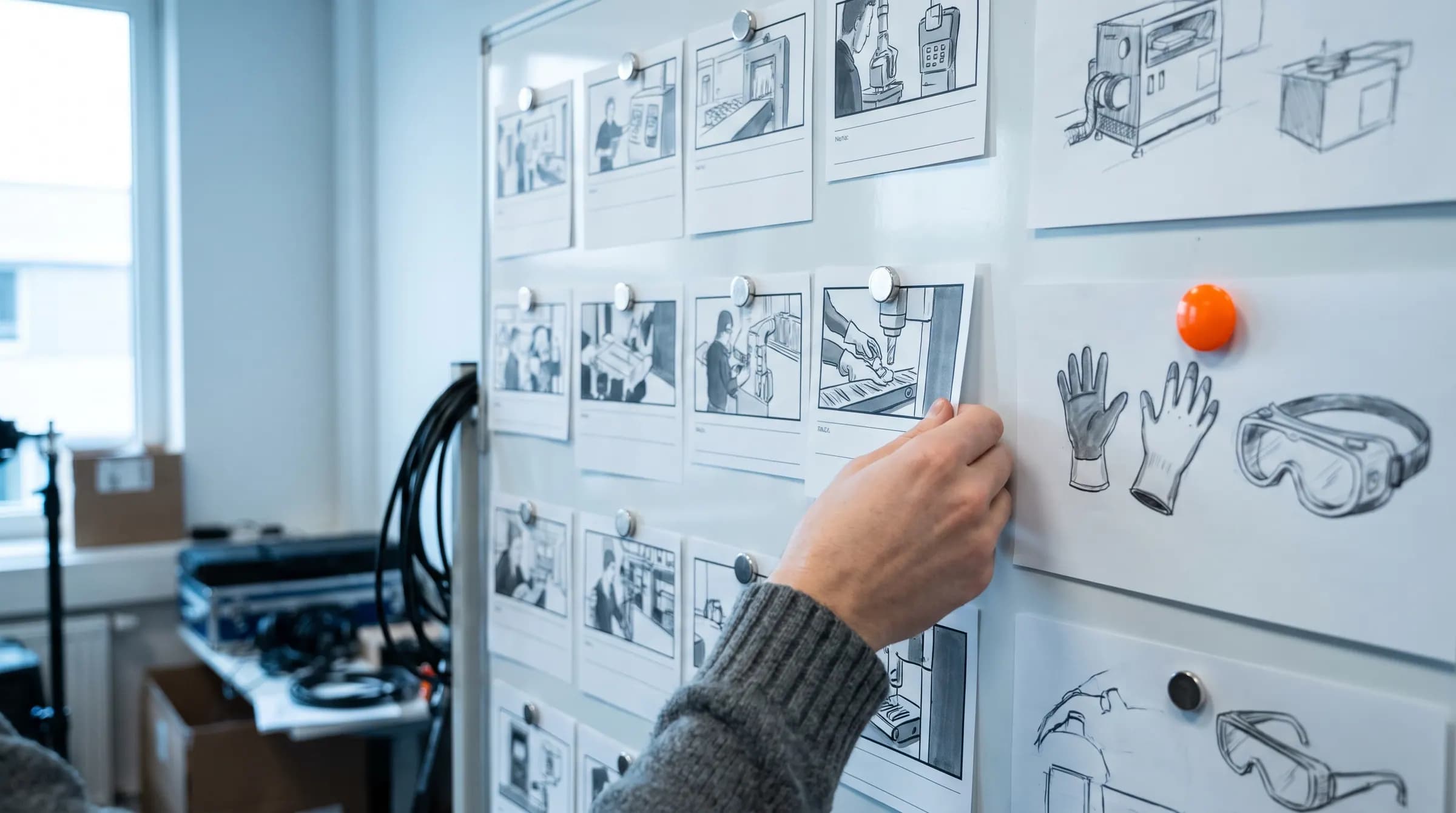
At EverLearn the script and the storyboard go to the client to confirm first, and nothing moves on before that. This step belongs to your process owner, who checks three things.
- Whether the terms match the words used on the floor.
- Whether the order of the steps matches the way the task is done.
- Whether every value, unit and tolerance is correct.
Before a course goes live this is the most important step. If one value is wrong, everyone after learns it wrong.
Remember this
One lesson, one thing. One action per line. A why with every key point. And a last question that tests a decision from the floor.